Thursday, 25 October 2012

Koenigsegg's horizontal roller coaster


Accelerating a standstill to 186 mph in 14.5 seconds is a fairly kinetic event. Very loud, tunnel vision, urge to pee. One moment the Swedish countryside is just sitting there, looking lovely and serene; the next it's blowing past you in a violent blur of autumn colors. Herregud! I've been pillaged.

The Koenigsegg Agera R, built by an extraordinary man named Christian von Koenigsegg, in Angelholm, Sweden, last year laid waste to a bunch of Guinness production-car records, among them: zero to 186 miles per hour and back to zero in 21.19 seconds. The very car I'm driving, in fact. And it is, it feels like, a horizontal roller coaster: At rest, the Agera R always seems poised in space, then hit the gas, over the top, and straight down, bang, bang, bang go the gears. A plunging vertigo takes over, a forward free-fall. The momentum builds in inexorable squares of mass and you scream your face off. Welcome to Six Flags Over Sweden.

The Agera R—$2.5 million or so, about 1,000 to 1,140 horsepower (depending on fuel), about 3,200 pounds—continues to crush passengers in excess of 1g of linear acceleration until somewhere north of 100 mph, at which point the car's aerodynamic shape begins to exert significant downforce (660 pounds at 155 mph). The rate of acceleration levels off but it's still going upstairs like crazy (124 to 186 mph takes 7 seconds). This is telemetry as pornography.

Mr. Koenigsegg estimates the car's top speed would clock in around 273 mph—faster than the Bugatti Veyron Super Sport's record of 267.8 mph—if, that is, he could find some stretch of Mars upon which to test it. On the company's conveniently located airfield, the prudent visitor gets on the brakes after touching 186 mph (I hit 190). The braking event from that speed requires less than 7 seconds and is likewise vigorous. It feels like your pants are going to fall off.

In short, the Agera R is the thing that eats bats out of hell. I am overawed. And yet, it does seem an unlikely obsession for the reserved and purposeful Christian von Koenigsegg.

There had been some concern that Koenigsegg was in financial trouble, and Mr. Koenigsegg, 40, admits business could be easier. The European market has lately fallen off the Earth. With an annual turnover of about €10 million ($13 million), he says, on 12 to 15 cars, Koenigsegg's financial aspirations are modest and the business is, for the moment, stable. "We're never going to make a personal fortune," he says in his IKEA-decorated office, in a former air-force maintenance facility. "The only reason we are still here is we accepted we were going to be small."

My first visit to Ängelholm was in the mid-1990s, when the young Koenigsegg tried to kill me in one of his prototypes. He was a singular figure even then, as bald as the laughing Buddha—Mr. Koenigsegg suffers from alopecia but sort of rocks it, too. In those days he was building his reptilian hypercar in a quaint thatched-roof barn, which in due course burned down in 2003.

The base's jet hangers proved an ideal workspace for Koenigsegg, and today the company's 52 employees quietly bustle through the day, hand-building amazing cars for ridiculous people. On the floor at the moment is a Popsicle-purple Agera R with gold-anodized cockpit appointments, destined for a customer in Shanghai. And they put Martha Stewart in jail.

As a matter of industrial policy, the Swedish government has de-emphasized the domestic car business—note its refusal to bail out Saab—in favor of cleaner, information-based industries and IT. This has suited Koenigsegg well since the company's strategy is to take the essential car—the carbon-fiber core that Mr. Koenigsegg imagined two decades ago—and perpetually evolve it using the power of computer-assisted engineering in the hands of a few massively talented designers. As I walk through the offices, one of the staffers is redesigning the car's proprietary front-brake calipers, which is no trifling matter; another is using a CAE/fluid-dynamics program to refine the airflow around the front valence.

"Building a car like this is about fighting physics," he says. "I'm not sure committees fight physics better than a few great guys."

The Agera R's mugging of Newton begins with a bespoke, race-spec, dry-sump 5.0-liter, twin-turbocharged V8 weighing a mere 435 pounds and boasting some staggering statistics: 228 hp/liter of displacement; 737 pound-feet of torque from 2,700 to 7,300 rpm, with redline at 7,500 rpm; and a brake mean effective cylinder pressure (BMAP) of 28 bar, about 406 psi, which would blow most gas engines' spark plugs to the moon.

And the sound? Your ears are going to need condoms.

Sorry, it's about to get all geeky in here: The longitudinally midmounted V8 transfers power to the limited-slip e-diff through a Koenigsegg-designed seven-speed gearbox, with a twin-disc dry clutch and an 11-disc wet clutch arranged sequentially, working cooperatively, rather like a dual-clutch automated manual transmission. Still, under the best of circumstances, the Agera R's gearshifts are rough, and at light throttle and low speeds the car can buck and lurch like a poisoned pony.

The Agera R is hard-core in every way you'd hope: carbon-aluminum monocoque; stressed engine and gearbox; chro-mo subframes; pushrod suspension; adaptive damping, ride height and aero. For 2013 the company is offering astonishing, hollow carbon-fiber wheels—the front wheel with tire weighs less than 25 pounds. Other upgrades include a new spring-loaded, adaptive rear wing and the Triplex rear suspension, comprising a bidirectional hydraulic strut mounted horizontally between the pushrod rockers. My test car doesn't have the Triplex rear suspension. Mr. Koenigsegg says it improves the car's antisquat characteristics.

And speaking of squat: I know squat about how the Agera R handles. Considering the forces involved, the car is reasonably manageable on narrow, and wet, Swedish roads, just. It does have an amazing turning radius! You can turn this thing around in a drive-through. Mr. Koenigsegg assures me that his new car will pull in excess of 1.6 g lateral acceleration, and he is pondering a sub-7-minute go at the Nürburgring. Yahoo.

She's not for the timid, that's for sure. Holding the revs at around 6 grand produces a galling, blasting staccato that could alert NATO. The cabin is rakish and dead cool, and the electronic amenities, the navigation and driver instruments, are first-rate. The driving position is like being a ball-turret gunner on a star destroyer.

Want one? You're in luck. Mr. Koenigsegg has gone to the trouble of federalizing the Agera R—U.S. sales began this month—which, among other things, required developing a multimode stability-control system. Much needed, too. The Koenigsegg's 44/56 front/rear weight distribution, combined with the low polar moment of the midengine layout, makes the Agera R what you might call excitingly neutral. The stability control will help keep rich guys out of the hedges.

But, clearly, the Agera R is not about nimble handling. From a man who is one of the most peaceable presences I've lately encountered, a gentle giant of a mind, this car is nothing but a weapon: a very large, very Norse, not-all-that-pretty ax meant to be thrown with staggering force at a great distance. You, dear reader, are looking at the fastest street car in the world.

Honda Fit She’s, the world’s only car aimed exclusively at women


Around the world, building and designing cars remains a male-dominated business, and many companies live by an old axiom that women will buy a man's car but men won't buy a woman's car. While a few companies have attempted to bend that rule, only Honda has chosen to embrace it with the Honda Fit She's -- the only model built by an automaker today aimed exclusively at women. Hope you like pink, ladies.
There's a long and embarrassing history of automakers attempting to lure women with ladies-only models. At the turn of the 20th century, electric cars were marketed to wives with the pitch that their lack of hand-crank starting would avoid broken shoulders and/or death. In 1955, Chrysler made a bid for feminine attention with the Dodge LaFemme -- which came in a two-tone pink-and-white paint scheme, along with a storage place for the matching purse and rain hat. Lest you think modern executives learned from errors of the past, in 2000 Ford showed off a concept Windstar minivan developed with Maytag featuring a compact washer/dryer, microwave and vacuum in the rear hatch, because why would a soccer mom ever want to be parted from her appliances?
As women have grown to buy more cars in recent decades -- accounting for about one-third of car shoppers in the United States -- such attempts have given way to more savvy marketing. But in Japan, the gender divide remains more stark; half of all working-age women stay out of the workforce due to more stringent societal pressure to choose homemaking over careers, a major reason Japan's economy has been stuck in a rut for decades. But there's a cohort of younger Japanese women putting work first, and in a weak market Honda sees an opening.
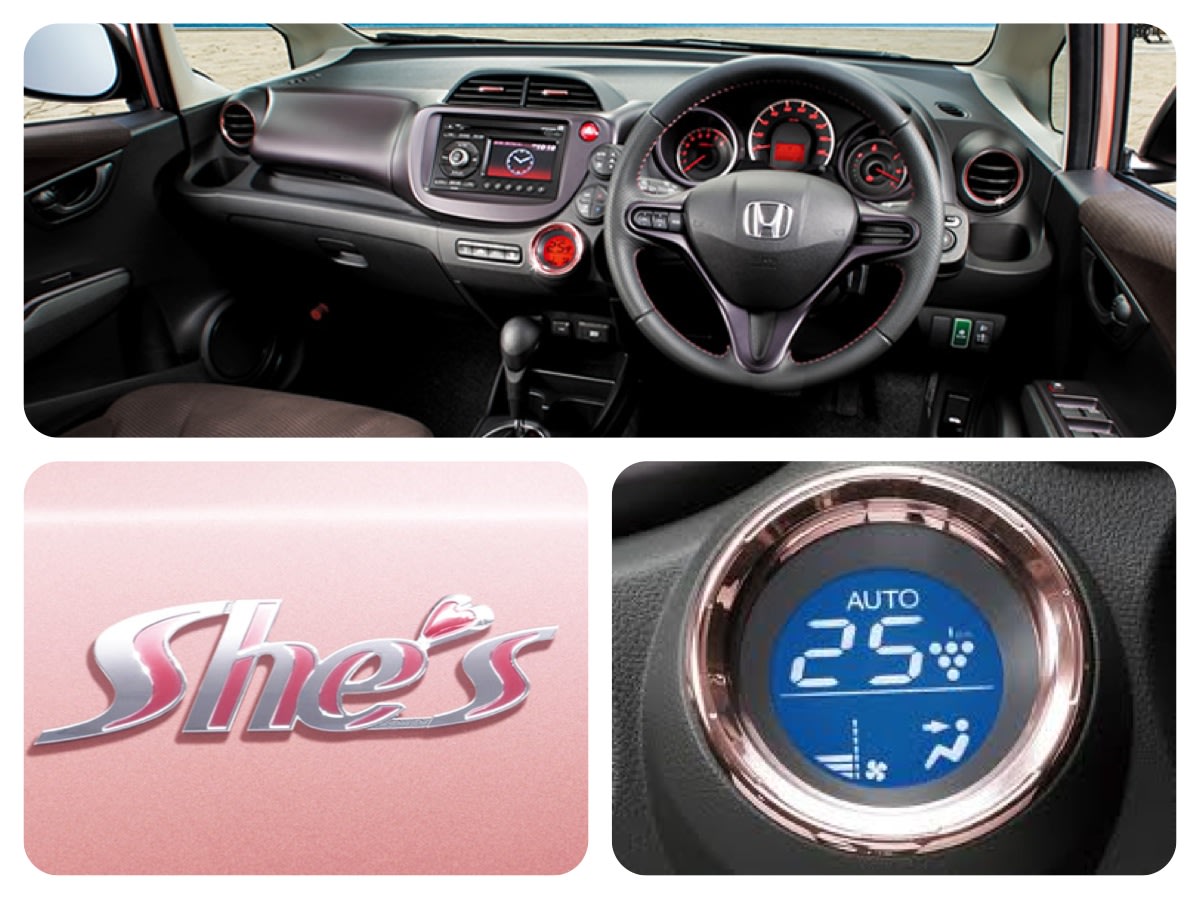
Launched this summer, the Honda Fit She's designers say they wanted to take a regular Fit subcompact and make it in their words "adult cute." That means lots of pink: Pink stitching in the seats and steering wheel and floor mats, matched by pink metallic bezels around the shifter and displays. There's also a few extra shades of pink in the special She's badge, spelled with a heart for an apostrophe. If pink isn't a customer's style, Japanese buyers can also select a Fit She's in shades of brown and white that a Honda executive told the Yomuri Shinbun newspaper match the color of eyeshadow.
To Honda's credit, the Fit She's beauty treatment isn't just skin deep. It also comes with special windshield glass that cuts 99 percent of ultraviolet rays and a "Plasmacluster" air conditioning system that Honda claims can improve a driver's skin quality, all aimed at stopping those wrinkles that turn adult cute into just adult. With a starting price of $17,500, the Fit She's got an attractive price for a home-market Japanese car -- but automakers wouldn't need special editions if taking advice from women wasn't such a noteworthy event.

Friday, 31 August 2012

9 diesel cars and trucks that will save you money


Diesel vehicles get remarkable fuel economy, but it’s sometimes not enough to make them a better value overall than their gas counterparts.

The main reason is the higher pricetag: on average a diesel is $5,045 more than a gas-powered version of the same model, according to Vincentric LLC, a research firm in Bingham Farms, Mich.

Beyond the purchase amount, diesels also end up costing a little extra to own and maintain. That’s partly because some new diesel vehicles are required to have a reservoir of urea, which gets injected into the exhaust and neutralizes some of the pollutants.

With this so-called “clean-diesel” technology, emissions are now cleaner than what comes from many gasoline vehicles—which is a major role reversal. But there is added maintenance involved in replenishing the reservoirs and making sure the more complex diesel engine is running properly.

“We found that diesels typically have slightly higher insurance, repair and maintenance costs,” says David Wurster, president of Vincentric, which specializes in calculating total cost of ownership and chose diesels for its most recent alternative fuel analysis.

“An additional noteworthy point is that on a percentage basis, diesels have lower depreciation, but because they cost more to purchase, their total dollars of depreciation are higher,” Wurster says. (Some might argue that diesel is not technically an alternative fuel, but it’s not exactly mainstream in the United States either, given that only a small fraction of vehicles use it.)

The Diesel vs. Gas Showdown

Vincentric analyzed 23 diesels on sale in the United States—11 of them classified as commercial vehicles and 12 as consumer vehicles. It looked at overall cost of ownership for five years, with 15,000 miles driven annually. Based on this analysis, nine diesels had five-year ownership costs that are lower than equivalent models with gasoline engines. We list them in descending order based on overall savings versus their gas equivalents.

Vincentric, a research firm in Bingham Farms, Mich., specializes in calculating cost of ownership for vehicles and tracks more than 2,000 models. Nine factors go into its cost of ownership calculations: purchase price, depreciation, financing, fees and taxes, fuel, insurance, maintenance, repairs and opportunity cost. The price it uses for fuel is a weighted national average for the previous five months, to better reflect market trends, rather than market extremes.


2012 Mercedes-Benz GL350 Bluetec 4Matic

Overall savings compared with the gas-powered GL450 4Matic: $10,128
Fuel savings: $4,750

The GL-Class is Mercedes’ largest crossover. It was refreshed for 2012 with minor styling changes. The GL350 Bluetec has a 3.0-liter V6 turbodiesel that puts out 210 hp and gets an EPA-estimated 17 mpg city, 21 mpg highway and 19 mpg overall.

Its substantial fuel savings** of $4,750 helps the GL350 Bluetec achieve the highest total savings of any diesel vehicle for which Vincentric calculated five-year ownership costs. Vincentric estimates that the purchase price* is only $101 higher than that of the gas-powered GL450 4Matic.


2012 Mercedes-Benz S350 Bluetec 4Matic

Overall savings compared with the gas-powered S550: $6,015
Fuel savings: $4,003

The Mercedes S350 Bluetec 4Matic is the least expensive S-Class model. It is one of just a few diesel vehicles in Vincentric’s study with a lower purchase price relative to its gas-powered counterpart.

Just going on the suggested retail price, the diesel S350 is $2,450 less than the S550, which has a V-8 engine that runs on gasoline. But Vincentric, which tries to ascertain what buyers are actually paying, pegs the S350 purchase price* at $3,418 less.

The S350 is the only S-Class model with all-wheel drive. The others are rear-wheel drive, which makes its fuel savings** of $4,003 more remarkable. It has a more powerful version of the 3.0-liter V-6 turbodiesel that’s in the Mercedes GL350 Bluetec. The engine produces 240 hp and gets an EPA-estimated 21 mpg city, 31 mpg highway and 25 mpg overall.


2012 Volkswagen Touareg TDI

Overall savings compared to gas-powered Touareg: $4,447
Fuel savings: $2,840

The VW Touareg Diesel is a pricey midsize crossover with rugged capabilities. Its 240-hp V-6 gets 19 mpg city, 28 mpg highway and 22 mpg combined, according to the EPA—respectable for such a large and heavy vehicle.

Its purchase price* is $3,322 higher than the gas-powered Touareg. But taking into account its five-year cost of ownership, Vincentric estimates that the diesel will end up saving owners a total $4,447 over the gas model—including a $2,840 fuel savings**.


2012 Audi A3 2.0T TDI

Overall savings compared to gas-powered A3 2.0T: $3,583
Fuel savings: $3,793

The A3 is the smallest car Audi sells in the United States. It’s only available as a four-door hatchback. Vincentric estimates that the purchase price* of the diesel A3 is $1,630 higher than the comparable gas-powered version.

The A3 2.0T TDI is less expensive to insure and maintain versus the gasoline version of the A3. That combined with fuel savings** of $3,792 make for a lower five-year cost of ownership. The EPA estimates fuel economy of 30 mpg city, 42 mpg highway and 34 mpg combined.


2012 Mercedes-Benz R350 Bluetec 4Matic

Overall savings compared to gas-powered R350 4Matic: $3,181
Fuel savings: $1,832

The R-Class is Mercedes’ version of a minivan, except with rear doors that swing out, rather than slide open. The diesel R350 Bluetec 4Matic has a purchase price* $844 lower than that of the gasoline R350 4Matic. Vincentric also calculates significantly lower depreciation for the diesel version versus the gasoline one, saving owners $2,142 over five years.

The R350 Bluetec 4Matic uses the same 210-hp 3.0-liter V-6 turbodiesel as the GL350 Bluetec 4Matic. The EPA estimates fuel economy of 18 mpg city, 23 mpg highway and 20 mpg combined. Sales of the R-Class have been sluggish ever since its introduction for the 2006 model year. After 2012, it will no longer be available in the United States.


2012 BMW X5 xDrive35d

Overall savings compared to gas-powered Touareg: $4,447
Fuel savings: $2,840

Never mind that BMW X5 xDrive35d has an awkward name—this midsize crossover is a good value. It’s one of only three diesels with a purchase price* as calculated by Vincentric that is lower than that of its gas-powered counterpart, the BMW xDrive35i, albeit just $597 lower.This lower price has a positive domino effect on five-year ownership, allowing for lower depreciation, finance and other associated costs. Only insurance and repairs are higher with the diesel X5, but not by much. With fuel savings** of $2,405, the diesel handily beats its gasoline counterpart, saving $2,751 over five years. The X5 xDrive35d features a 3.0-liter six-cylinder turbodiesel engine with 265 hp. It gets an EPA-estimated 19 mpg city, 26 mpg highway and 22 combined.


2012 Mercedes-Benz ML350 Bluetec 4Matic

Overall savings compared to gas-powered ML350 4Matic: $2,473
Fuel savings: $2,336

Mercedes’ midsize ML350 Bluetec crossover gets the 240-hp version of the company’s 3.0-liter V-6 turbodiesel, with an EPA estimated fuel economy of 22 mpg city, 27 mpg highway and 22 mpg combined.

Although its purchase price* as estimated by Vincentric is $1,397 higher than that of the gas model, the diesel saves owners $2,336 in fuel costs** and $767 in maintenance over five years of ownership. Factoring in slightly higher finance, insurance and repair costs versus the gasoline version, the ML350 Bluetec saves owners a total of $2,473 over five years.


2012 Mercedes-Benz E350 Bluetec

Overall savings compared to gas-powered E350: $2,204
Fuel savings: $3,145

The gas-powered midsize E-Class sedan is one of Mercedes’ most popular models. The E350 Bluetec diesel sells in far fewer numbers. It costs $1,965 more to purchase* than a gas-powered E350. Besides that, the diesel E350 Bluetec has marginally higher costs in nearly every category that Vincentric tracks, including most notably finance and repairs.

But its impressive fuel savings** of $3,145 help compensate for it all and result in savings of $2,204 over five years of ownership when compared to its gasoline counterpart. The E350 Bluetec has a 210-hp 3.0-liter V6 turbodiesel that gets an EPA-estimated 21 mpg city, 32 mpg highway and 25 mpg combined.


2012 Ford F-350 Diesel

Overall savings compared to gas-powered F-350: $1,131
Fuel savings: $1,999

Of the seven full-size, heavy-duty diesel pickup trucks Vincentric studied, the Ford F-350 is the only one with five year ownership costs that are lower than that of its gas-powered equivalent.

The Ford F-350 Diesel has a 400-hp 6.7-liter V-8 turbodiesel engine. Although it only has 15 hp more than the gasoline 6.2-liter V-8 also offered in the F-350, it has almost double the torque, at an impressive 800 lb.-ft. What that means in practical terms is that the F-350 Diesel is more capable at towing and hauling heavy loads. It also depreciates less, according to Vincentric, retaining $822 more of its value over five years of ownership than the gas-powered F-350. That and its impressive fuel savings** help the F-350 Diesel overcome its $5,355 higher purchase price* and higher ownership costs, resulting in savings of $1,131 over five years of ownership compared with its gas counterpart.

Forget 3D. Your dream TV should be 4K


The 3D-TV fad seems to be fading -- and giant, cinema-style 4K sets are the newest cutting-edge tech marvels destined for your living room.
A truckload of new TVs, with screen resolutions four times greater than so-called full HD screens, are being unveiled at this week's IFA technology show in Berlin. The screens -- referred to as 4K or ultradefinition -- were among dozens of new gadgets on display for the 250,000 people who descended on Berlin's conference halls.
The show features gear ranging from big-screen smartphones to self-stirring cookware, but the big buzz this year is about 4K. The first sets should be available for preorder this fall. There were still plenty of 3D screens, including a 103-inch Panasonic set that doesn't require viewers to wear 3D glasses. The excitement over them, however, seems to be dying down.
The new 4K sets from LG, Panasonic, Sony, Samsung, and Toshiba show a level of detail you'd expect on a movie screen; their resolution equals that of professional cinema cameras, like the Red One. The detail is stunning, and viewers can comfortably sit close to the screen. Even from only a few inches away, it's impossible to discern a single pixel.
Sony claims that chips in its flagship set can scour normal Blu-ray films and display extra details, producing pictures far sharper than what normal sets can offer. In demonstrations, films looked stunning on the new screens.
Not to be outdone, Panasonic teamed up with Japanese broadcaster NHK to create an 8K set -- with resolution four times greater than its rivals' and 16 times greater than Full HD.
There is just one problem, of course: storage. There is no media suitable for storing 4K films just yet. Normal Blu-ray discs aren't designed for the new format. In Berlin, most tech companies demonstrated their sets with slow-motion landscape videos.

Other TV tech impresses, too
Another new screen technology – OLED, or ‘organic light-emitting diode” -- made a splash at the IFA tech show. The ultrathin sets produce a much crisper, brighter image than a typical HDTV. The technology has become standard in smartphones like the Samsung Galaxy S3, but it's only starting to make its way to bigger screens. Unlike conventional TVs, this one has no backlight. The pixels themselves light up, allowing for deeper blacks and sharper contrasts. At IFA, Samsung introduced a 55-inch TV, the world's biggest OLED set.

Samsung showed off other TV tricks, as well. One lets two people watch two different shows at the same time. The images for one show alternate with the images for the other at an extremely high speed. Each person wears 3D glasses that have tiny shutters inside that flicker in time with their show's images.
Samsung's new models also have motion controls, courtesy of a tiny camera that catches movement. Viewers can control the TV's volume and even play video games by simply moving their hands.

Smart appliances and a self-stirring pot
The IFA also showcased gadgets that let people control smart appliances from a tablet.
Panasonic's new refrigerators, air conditioners, washers, and dryers will all be app-controlled. Users can switch them on and off from anywhere, and monitor their usage for peace of mind.
Samsung unveiled apps for its Galaxy tablet to control dishwashers, air conditioners, and other appliances.
Philips brought out celebrity chef Jamie Oliver to demonstrate its vision of "Jetsons"-style kitchenware: a high-tech pot that chops, stirs, and heats food on its own. The Home Cooker is a computer-controlled food processor and pot all in one. The device can stir risotto and even cook a curry in the base of the unit while steaming rice above it.
The IFA was also packed with computers, and there was a lot of buzz around a laptop-tablet hybrid that runs Windows 8. The slim, light gadget is essentially a touch-screen tablet with a keyboard that snaps or slides into place.
Dell's XPS Duo machine looks particularly glamorous, with a superslim Ultrabook body that swivels out to become a tablet. HP and Toshiba also unveiled dual-purpose machines.
Hundreds of companies will show off their wares tomorrow at IFA, with gadgets ranging from the lustworthy (new high-end Sennheiser headphones) to the slightly ridiculous (dancing robots fromVietnam's Tosy Robotics). The best of the bunch may end up in your living room not too far down the road.

Thursday, 30 August 2012

7 Ways to Dress Up Your Company's Facebook Page


PCWorld's Facebook page without custom tabs (upper left) and with tabs added (lower right)PCWorld's Facebook page without custom tabs (upper left) and with tabs added (lower right)Facebook can be a great marketing tool and communications outlet, but there is only so much that you can say in brief status updates and plain-text fields on your About page. If you really want to put Facebook to work for your business, you'll need to explore the option of adding tabs—clickable images of extra pages—to your profile. Done creatively, tabs encourage visitor engagement and showcase your content. They let you post quizzes and polls, and they can display your content from other social networks, such as Twitter and Pinterest.
If you lack the coding skills to create custom tabs using Facebook's development platform, the following Facebook apps can help. Some enable you to apply fully customized Web pages as additional tabs—a great way to add content about your products, services, and company culture.

1. Iframe Apps

The IFrame App is among the simplest for dressing up your Facebook presence.The IFrame App is among the simplest for dressing up your Facebook presence.Iframe Apps is one of the simplest custom tab wizards, letting you add two tab pages to your Facebook Page. You can either specify an existing URL or insert text and HTML to display on your custom tab, and define a specific frame height to fit the length of your content. The "fan gate" feature lets you display an image or custom text to encourage visitors to “like” you before viewing the main content.
Keep in mind, though, that to insert HTML code with images or videos you’ll need to upload the files elsewhere since Iframe Apps doesn’t offer online storage.
The free service displays its logo on your page footer. The premium services, starting at $9.90 per month after a free 7-day trial, allow you to remove ads.

2. FanBuildr

Hosted iFrame offers a WSIWYG editor.Hosted iFrame offers a WSIWYG editor.FanBuildr is a more advanced app that lets you add up to ten tab pages to your Facebook Page. The free service is available to all pages with 25,000 fans or less, and shows a small promo on the footer of your custom tab page. Its premium services, starting at $5 per month, remove ads and let you create unlimited tabs.
When inserting your text or code for the custom tab, you can define different content to display to visitors, depending on whether they "like" your page. A WYSIWYG editor lets you format text and add links or images, with both code and visual views. You can upload up to 25MB worth of files per page—or 250MB and beyond if you subscribe to the premium services. You can also enter your Google Analytics code to track traffic to your Facebook tab.

3. Static Iframe Tab

Check out Static Iframe Tab for adding 20 or more tabs.Check out Static Iframe Tab for adding 20 or more tabs.The Static Iframe Tab from Woobox lets you add over 20 tabs to your Facebook page. The basic functionality is free, and free of Woobox branding.
What do you want to display on a tab? You can choose a URL, an image, or HTML code. You can also specify a nonfan page source. A WSIWYG editor enables formatting and edits, letting you switch between the code and visual view. The free service includes visitor analytics to display stats for page views, visits, and likes, segmented both by fans and nonfans who view your tab.
Their premium services, starting at $10 per month, allow you to limit access to the tab page—for instance, you can require users either to fill out a form or to have a certain number of Facebook friends who like your page.

4. Extended Info

Extended Info lets you add a tab that’s similar to and alongside the usual About page, but with more details—so you can display things, such as products, with text, HTML code, or videos. You can organize the content via bulleted, numbered, or paragraph lists, each with a custom heading name.

5. Twitter Tab App

Extend your tweets to Facebook with Woobox.Extend your tweets to Facebook with Woobox.Need to publicize your Twitter presence to your Facebook fan base? This free app from Woobox adds a tab to your Facebook Page displaying your Twitter Profile and Tweets, with a small ad link on the bottom of the tab.
In the Twitter tab settings you can choose to display all tweets or only those containing a given search term. You can also optionally hide Tweets that start with @ and hide your Twitter profile background. Additionally, you can enable the fan gate so only Facebook users who “Like” you can see your Twitter tab.

6. Pinterest Tab

Here's a great way to share your Pinterest content to Facebook users who aren’t on Pinterest. This free app, also from Woobox, puts a tab on your Facebook Page showcasing your Pinterest boards and pins, with only a small ad on the bottom. Facebook visitors can browse your Pin boards, and click on them to view your Pins inside your Facebook tab page. When they click on a Pin it opens a new browser window to the Pin on Pinterest.
You can choose to have your Pin tab show all or only select Pin boards—and enable Facebook Like & Send buttons on Pins, to encourage visitors' sharing to their Facebook friends. The Fan Gate feature allows only Facebook users who "like" you to see your Pinterest tab.

7. Fan Appz

This free platform helps you add content and analyze your Twitter and Facebook traffic. Fan Appz lets you post updates to both social sites at once, target specific countries and languages, schedule posts in advance, and create and publish quizzes and polls. Image-based polls let you give users a list of images—maybe of your products—and they can share their preferred top five.
The premium services, designed for larger fan pages, let you create and publish promotions, including special offers, sweepstakes, challenges, and rewards. You can create a gift store and games, and manage your Places and Events. You’d also be able to view the analytics of your posts, engagements, and promotions—all with support for Google Analytics.

You Can Write, But You Can't Hide: Big Data Knows Your Writing Quirks


As I wrote recently, data scientists have been able to decode unstructured data to accurately predict where violence will occur in Afghanistan. Now, they can also mine unstructured data to determine the identity of a document’s writer. All of us, it seems, have a “write-print” as unique as our fingerprint.
According to forensic linguists, the experts who investigate a text’s originator, if they have an individual’s known writings, they can detect with up to 95% accuracy that person’s authorship of any other document. Forensic experts have been called as witnesses in the high profile lawsuit by Paul Ceglia, who has sued Mark Zuckerberg, claiming he owns half of Facebook. They’ve also been expert witnesses in murder trials.
While the field of forensic linguistics predates the advent of big data, the sheer volume of data being generated on the Internet is opening new business opportunities for automating the analysis. A company pursuing these opportunities claims it can pinpoint a document’s author and determine everything from the gender, age, and education of a writer to the veracity of the document’s content.
But some analysts don’t even need to have access to known writings of a person to determine a document’s authorship. Using hundreds of thousands of publicly available emails from Enron employees, a group of computer scientists from Concordia University in Montreal tested their approach of clustering documents of unknown origin to identify those written by the same person. While they note that more research is needed, these scientists believe their clustering technique can be used by investigators of cyber crimes where all they have as evidence is a massive amount of suspicious e-mails, text messages, or other written material.
Although no forensic linguist would claim that their analysis is equal to comparing a person’s DNA for identification purposes, they are confident they can find those stylistic quirks in our prose that makes us all individuals—even if the writer is trying to intentionally obfuscate who he or she is by, say, pretending to be illiterate when, in fact, the writer is a college graduate.
Big data is boosting forensic linguistics as a tool to be used in criminal investigations and the courts to seek justice. It’s one more way analytics is improving modern life.

Lenovo IdeaCentre A720 Review: Full-Tilt Digital Media Maven


Windows 8 is getting closer to release and the amounts of quality all-in-one desktops are on the rise; the Lenovo IdeaCentre A720 is a strong choice. The A720 offers a 10-point multi-touch screen, making it ready for Microsoft’s upcoming Windows 8 operating system.

Big, Beautiful Screen

This 27-inch system ($1599 as of 8/23/2012) strongly resembles a TV; being a digital media machine is its strongest attribute. A Blu-ray drive is included and HD content looks great on the high-definition, 1920-by-1080 resolution screen. As with many all-in-ones that double as a television, a remote control gives you easy access to the Media Center features, and the optional TV tuner gives you access to other TV functions. The A720 uses Dolby Home Theater 4, which produces more-robust sound quality from tiny stereo speakers. However, bass content is lacking since no subwoofer is included. The A720 strives to be in the center of the living room rather than just a PC on the corner desk.
The A720 stops being just a TV once you get your hands on it—literally. It supports 10-point multi-touch gestures and can be angled anywhere from -5 degrees to a 90-degree flat plane. There are few TVs that can claim to be a touchable table, though I don't recommend eating or setting drinks on it.
Having a big, fancy screen is well and good, but it won't mean much if performance is lacking. Luckily for the A720, the included Intel Core i7-3610QM runs at 2.3GHz but can boost itself to 3.3GHz when needed, thanks to Intel’s Turbo Boost technology. And 8GB of DDR3 RAM helps performance by improving response times.

Performance

The A720 managed to score only a 78 on our strenuous WorldBench 7 benchmark suite. This score means the system is approximately 22 percent slower than our baseline system.
The true culprit behind the lower score is the slow 40-second boot-up time caused by the 1TB 5400-rpm hard drive, a problem that's exacerbated by the tons of preinstalled apps that load up when Windows starts. This shouldn’t be a huge issue if you rarely shut down your computer, but it's something to keep in mind if you transfer a lot of data to and from your hard drive.
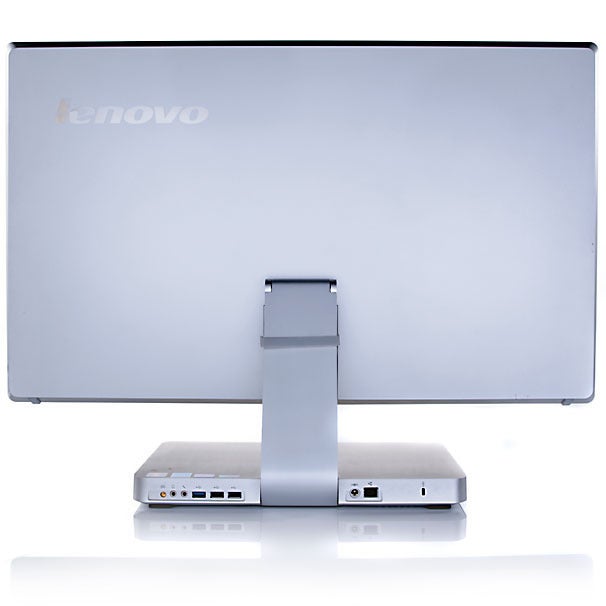
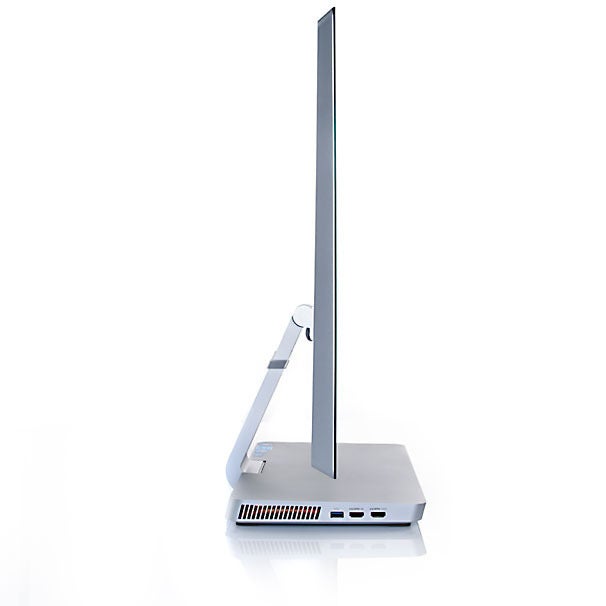
A key characteristic of all-in-one desktops is their slim profile. This system promotes itself as the thinnest 27-inch all-in-one in production (just 0.97-inch thick). Though extremely thin, it still comes packed with a discrete Nvidia GeForce 630M mobile GPU on top of Intel’s integrated graphics. While that may suffice for less-intensive games, DiRT 3 and Crysis 2 displayed at a maximum resolution of 1920 by 1080 pixels barely managed 29.8 frames-per-second and 13.8fps, respectively. The A720 does manage to reach 60fps on DiRT 3 at a resolution of 1680 by 1050 pixels and low quality settings; but the closest it gets on Crysis 2 at 1024-by-768 resolution with low quality settings is 48.1fps.

Gotta Love Those Apps

Lenovo loves apps, from Lenovo’s signature Lenovo Rescue System to some interesting organizational tools. Lenovo’s Vantage Tools (shortened to LVT) provides two stacks of “cards” that resemble on-screen index cards. These cards represent entertainment and maintenance. All of the A720’s popular applications are there, sorted by category. Think of it as a fancier, touch-enabled quick-launch toolbar. However, it’s slow to launch and not very intuitive. Another of Lenovo’s touch apps resembles a less-refined Windows 8: IdeaTouch 4.5 gives a menu that lists everything from photos to your eBooks in a tile format for some quick touch-based media selection.
Of course you can’t talk about apps without talking about games. There are plenty of fun little time-wasting games that take advantage of the multi-touch screen. Air hockey also spotlights the flexibility of the machine. Laying the system down as a flat table-like surface and situating a second player on the other side nicely simulates a miniature version of those fun nights in the arcade. Most machines like this take pride in being a family-friendly machine. ArcSoft’s PhotoStudio Paint is a more glorified Microsoft Paint for kids that lets them unlock the inner artist. Flipping through the applications page will yield tons of fun little things like these for showing off or killing time.
The A720 comes with a wireless mouse and keyboard that have surprisingly little media capability. They work fine at a distance, but you must use the function button to pause or play. The system also comes with a front-facing 720p camera and a built-in microphone for easy and clear video-chatting or recording fun home movies with Lenovo's “Camera Fun Zone.”
For connectivity, the A720 comes with a standard 802.11n wireless adapter and a Gigabit Ethernet port with Bluetooth enabled. On the base of the system are two USB 3.0 ports, two USB 2.0 ports, a flash memory card reader, and a TV Tuner. Both HDMI-output and -input ports are also included. Hook up a console, or use the A720 to play a movie on a big screen—the ports gives you plenty of options.
If you’re looking for more of a bargain and are willing to sacrifice a little graphics power and screen size, the Sony VAIO L24 would be a good alternative. The L24 costs $1400 (as of May 24, 2012) and scored higher on our benchmarks. It has a 7200-rpm hard drive for quicker booting and file transfers, but it lacks a discrete graphics card, relying on Intel’s HD Graphics 4000 from its Intel Core i5-3210M. The screen is still multi-touch–capable and features high-definition 1920-by-1080 resolution, but it's only 24 inches. Of course, not every room needs the larger screen, and the 3-inch deficit may prove to be worth the $200 savings.
The Lenovo IdeaCentre A720 is the perfect machine for a media-deprived room. If you're on a budget, there are better options out there; but if you want the whole shebang (with the exception of a quick hard drive and graphical power), you will be very happy with this purchase.