Wednesday, 14 November 2012

2013 Lamborghini Aventador LP 700-4 Roadster


2013 Lamborghini Aventador LP 700-4 Roadster announced

On the heels of the successful coupe introduced in 2011, the House of the Raging Bull is now offering the convertible version of the Aventador - the 2013 Lamborghini Aventadore LP 700-4 roadster.
The two-piece roof of the 2013 Lamborghini Aventador roadster is made entirely from carbon fiber. Each component is extremely light, weighing less than 6 kg. Being lightweight and simple to attach, the two parts can be easily removed and stored in the front luggage compartment.
The rear pillars in the new car have been redesigned to offer support for the removable roof, accommodate an automatic protection system for passengers and provide the engine compartment with ample ventilation. Engine hood also gets a bit of redesign and sports a more aggressive look than the coupe version.
2013 Lamborghini Aventador LP 700-4 Roadster
The 2013 Lamborghini Aventodor roadster features a powered rear wind screen and wind deflectors to keep civilized conversations going in the cabin area. The new Aventador LP 700-4 Roadster features new Dione 20'/21' rims with a daring, aggressive look. Crafted in light forged aluminum, they lower the weight of the vehicle by 10 Kg as compared with the standard set of rims.
A centrally located, 6.5 liter aspirated V12 generating 700 hp, an ISR 7-speed gearbox and push-rod suspension make the new Aventador Roadster a unique super sports car that accelerates from 0 to 100 km/h in only 3 seconds flat and has a maximum speed of some 350 km/h.
2013 Lamborghini Aventador LP 700-4 Roadster
Of course the Roadster's V12 also includes a cylinder deactivation system when the engine is working at partial capacity, while the innovative, instant Stop Start system includes high-performance capacitors known as supercaps to awaken the engine. This is an absolute first in the super sports car segment.
The new Lamborghini Aventador LP 700-4 Roadster is a dream that can be realized and ordered at any Lamborghini dealer in the world for the price of 300,000 euro, excluding taxes.

2013 Lexus LS launched in UAE


2013 Lexus LS launched in UAE

Al-Futtaim Motors, exclusive distributor for Lexus in the UAE, has announced the arrival of the new 2013 Lexus LS in the country. The model range includes the LS 460 - in standard and long wheel base versions, the LS 600h hybrid and an all-new LS 460 F SPORT.
Prices start from AED 325,000 for the base model of 2013 Lexus LS F Sport and goes right up to AED 495,000 for the top of the range long wheel base version of the luxury sedan. For the environmentally sensitive, the LS600h V8 top of the range hybrid car comes at a ticket price of AED575,000.
2013 Lexus LS
The 2013 Lexus LS is a re-skinned version of the already popular previous generation LS and gets the new family face - the splindle grille, smacked loud and clear on its nose. Not as much as the outside, the interior of the new LS has undergone a complete change and those who have owned a LS in the past will instantly notice this.
2013 Lexus LS
The 2013 Lexus LS sedan boasts 3 world's first and 15 Lexus first features. Advance Interior illumination, improved climate control system and pre-collision safety systems are touted as world first by the Japanese car maker.
The cars are now available in the showrooms across the country. If you are in the market for premium luxury sedan, the 2013 Lexus LS is a compelling car to keep in the potential buy basket.

2013 Honda Civic first images released


2013 Honda Civic first images released
The highly anticipated refreshed model of the ninth-generation Honda Civic is finally here. Honda has revealed the first look of the 2013 Honda Civic Sedan in advance of its debut at the 2012 Los Angeles Auto Show on November 29.
The vast majority of updates for the 2013 Honda Civic are only skin-deep and Honda says that the Civic has been 'honed to make the segment's best-selling car even better.' Up front there is a new open-mouth lower bumper with a horizontal chrome accent and a sportier, black honeycomb mesh grille anchored by new integrated fog lights on upper trims. The grille is flanked by new clear-lens corner lights to provide a better look. The more sculpted front end flows into a new, more deeply faceted hood, complemented by a collection of sharp new wheel designs.
2013 Honda Civic
In the back, a new rear bumper design and new rear trunk lid are capped by a clean, horizontal chrome trim piece. The all-new design of the jewel-like taillights now carries into the trunk face, providing a more upscale look. The rear bumper features integrated reflector treatments and a new lower diffuser panel finished with a honeycomb mesh vent. A host of new alloy wheels will also be offered.
Honda has not yet revealed any other details regarding the aforementioned 'safety, feature, comfort, chassis and interior styling enhancements' or even the mechanical changes that will round-out the 2013 Honda Civic. We certainly do hope there is more to offer as far as engine, chassis and suspension set-up is concerned.

2013 Audi A6 and A7 Black Edition announced


2013 Audi A6 and A7 Black Edition announced
Audi has unveiled Black Edition versions of the A6 and A7 in the UK. Each model will come with a set of rotor-design wheels and feature a lower sports suspension borrowed from the company's S Line kit. The rotor-design alloy wheels have a dark titanium finish and are a 20-inch diameter in the A6 Saloon and Avant or 21 inches in the A7 Sportback.
Designers swapped the standard grille, license plate surrounds and window trim for blacked-out pieces. Inside, the cars get Piano Black inlays which complement the sports seats upholstered in black Valcona leather and the black headlining. In the A6 models the foundation S line specification also brings features such as exclusive S line exterior and interior styling enhancements, satellite navigation, Bose sound system, light and rain sensors, xenon headlights and LED rear lights, the Audi drive select adaptive dynamics system, the Audi parking system plus and keyless go. On top of these, the A7 Sportback also includes extras such as powered tailgate operation, electrically adjustable front seats and a powered retractable rear spoiler.
2013 Audi A6 Black Edition
Buyers will have to wait until early 2013 to take delivery. Prices start at £35,010  for the A6 Sedan Black Edition and rack all the way up to £50,575 pounds for the A7 Sportback Black Edition. It’s still not sure as to whether the car will be introduced to the Middle Eastern market or not, but keep an eye on Auto MiddleEast.com for more info.

Tuesday, 13 November 2012

'World's Fastest Supercomputer' Crowned in US


In the clash of the world's supercomputing titans, a new U.S. supercomputer named "Titan" is king.
The $100-million Titan seized the No. 1 supercomputer ranking on the Top500 List with a performance record of 17.59 petaflops per second (quadrillions of calculations per second). The supercomputer, a Cray XK7 system based at Tennessee's Oak Ridge National Laboratory, leaped past the former champion, the Sequoia supercomputer at California's Lawrence Livermore National Laboratory.
The top five supercomputers in the world are:
  1. Titan Cray XK47 at Oak Ridge National Laboratory (17.59 petaflops/s)
  2. Sequoia BlueGene/Q at Lawrence Livermore National Laboratory (16.33 petaflops/s)
  3. Fujitsu's K computer at the RIKEN Advanced Institute for Computational Science in Kobe, Japan (10.51 petaflops/s)
  4. The Mira BlueGene/Q computer at Argonne National Laboratory in Lemont, Ill. (8.16 petaflops/s)
  5. The JUQUEEN BlueGene/Q computer at the Forschungszentrum Juelich in Germany. (4.14 petaflops/s)
U.S. supercomputers had fallen behind China's Tianhe-1A supercomputer and Japan's Fujitsu K Computer starting in 2009, but staged a comeback with Sequoia's rise in 2012.
Sequoia's 1,572,864 computing cores actually outnumber Titan's 560,640 cores, but not all computing cores are created equal. Titan draws 90 percent of its performance from having 261,632 of NVIDIA's new K20x accelerator cores.
The NVIDIA accelerator cores use the same graphics processing unit (GPU) technology that drives graphics cards for displaying video games. GPUs run tasks on many different "threads" that may run slower than traditional threads on central processing units (CPUs), but GPUs make up for that by running many more threads simultaneously.
GPU-driven supercomputers will become even more crucial in building the next generation of "exascale" supercomputers that would work 1,000 times faster than today's supercomputers. That's because GPUs use far less energy than the CPUs that have traditionally driven computing.
Titan used the new Tesla K20x accelerators to achieve an energy efficiency of 2,142.77 megaflops per watt (million calculations per second per watt), enough to also rank Titan No. 1 on the Green500 list of the world's most energy-efficient supercomputers.

Thursday, 25 October 2012

Koenigsegg's horizontal roller coaster


Accelerating a standstill to 186 mph in 14.5 seconds is a fairly kinetic event. Very loud, tunnel vision, urge to pee. One moment the Swedish countryside is just sitting there, looking lovely and serene; the next it's blowing past you in a violent blur of autumn colors. Herregud! I've been pillaged.

The Koenigsegg Agera R, built by an extraordinary man named Christian von Koenigsegg, in Angelholm, Sweden, last year laid waste to a bunch of Guinness production-car records, among them: zero to 186 miles per hour and back to zero in 21.19 seconds. The very car I'm driving, in fact. And it is, it feels like, a horizontal roller coaster: At rest, the Agera R always seems poised in space, then hit the gas, over the top, and straight down, bang, bang, bang go the gears. A plunging vertigo takes over, a forward free-fall. The momentum builds in inexorable squares of mass and you scream your face off. Welcome to Six Flags Over Sweden.

The Agera R—$2.5 million or so, about 1,000 to 1,140 horsepower (depending on fuel), about 3,200 pounds—continues to crush passengers in excess of 1g of linear acceleration until somewhere north of 100 mph, at which point the car's aerodynamic shape begins to exert significant downforce (660 pounds at 155 mph). The rate of acceleration levels off but it's still going upstairs like crazy (124 to 186 mph takes 7 seconds). This is telemetry as pornography.

Mr. Koenigsegg estimates the car's top speed would clock in around 273 mph—faster than the Bugatti Veyron Super Sport's record of 267.8 mph—if, that is, he could find some stretch of Mars upon which to test it. On the company's conveniently located airfield, the prudent visitor gets on the brakes after touching 186 mph (I hit 190). The braking event from that speed requires less than 7 seconds and is likewise vigorous. It feels like your pants are going to fall off.

In short, the Agera R is the thing that eats bats out of hell. I am overawed. And yet, it does seem an unlikely obsession for the reserved and purposeful Christian von Koenigsegg.

There had been some concern that Koenigsegg was in financial trouble, and Mr. Koenigsegg, 40, admits business could be easier. The European market has lately fallen off the Earth. With an annual turnover of about €10 million ($13 million), he says, on 12 to 15 cars, Koenigsegg's financial aspirations are modest and the business is, for the moment, stable. "We're never going to make a personal fortune," he says in his IKEA-decorated office, in a former air-force maintenance facility. "The only reason we are still here is we accepted we were going to be small."

My first visit to Ängelholm was in the mid-1990s, when the young Koenigsegg tried to kill me in one of his prototypes. He was a singular figure even then, as bald as the laughing Buddha—Mr. Koenigsegg suffers from alopecia but sort of rocks it, too. In those days he was building his reptilian hypercar in a quaint thatched-roof barn, which in due course burned down in 2003.

The base's jet hangers proved an ideal workspace for Koenigsegg, and today the company's 52 employees quietly bustle through the day, hand-building amazing cars for ridiculous people. On the floor at the moment is a Popsicle-purple Agera R with gold-anodized cockpit appointments, destined for a customer in Shanghai. And they put Martha Stewart in jail.

As a matter of industrial policy, the Swedish government has de-emphasized the domestic car business—note its refusal to bail out Saab—in favor of cleaner, information-based industries and IT. This has suited Koenigsegg well since the company's strategy is to take the essential car—the carbon-fiber core that Mr. Koenigsegg imagined two decades ago—and perpetually evolve it using the power of computer-assisted engineering in the hands of a few massively talented designers. As I walk through the offices, one of the staffers is redesigning the car's proprietary front-brake calipers, which is no trifling matter; another is using a CAE/fluid-dynamics program to refine the airflow around the front valence.

"Building a car like this is about fighting physics," he says. "I'm not sure committees fight physics better than a few great guys."

The Agera R's mugging of Newton begins with a bespoke, race-spec, dry-sump 5.0-liter, twin-turbocharged V8 weighing a mere 435 pounds and boasting some staggering statistics: 228 hp/liter of displacement; 737 pound-feet of torque from 2,700 to 7,300 rpm, with redline at 7,500 rpm; and a brake mean effective cylinder pressure (BMAP) of 28 bar, about 406 psi, which would blow most gas engines' spark plugs to the moon.

And the sound? Your ears are going to need condoms.

Sorry, it's about to get all geeky in here: The longitudinally midmounted V8 transfers power to the limited-slip e-diff through a Koenigsegg-designed seven-speed gearbox, with a twin-disc dry clutch and an 11-disc wet clutch arranged sequentially, working cooperatively, rather like a dual-clutch automated manual transmission. Still, under the best of circumstances, the Agera R's gearshifts are rough, and at light throttle and low speeds the car can buck and lurch like a poisoned pony.

The Agera R is hard-core in every way you'd hope: carbon-aluminum monocoque; stressed engine and gearbox; chro-mo subframes; pushrod suspension; adaptive damping, ride height and aero. For 2013 the company is offering astonishing, hollow carbon-fiber wheels—the front wheel with tire weighs less than 25 pounds. Other upgrades include a new spring-loaded, adaptive rear wing and the Triplex rear suspension, comprising a bidirectional hydraulic strut mounted horizontally between the pushrod rockers. My test car doesn't have the Triplex rear suspension. Mr. Koenigsegg says it improves the car's antisquat characteristics.

And speaking of squat: I know squat about how the Agera R handles. Considering the forces involved, the car is reasonably manageable on narrow, and wet, Swedish roads, just. It does have an amazing turning radius! You can turn this thing around in a drive-through. Mr. Koenigsegg assures me that his new car will pull in excess of 1.6 g lateral acceleration, and he is pondering a sub-7-minute go at the Nürburgring. Yahoo.

She's not for the timid, that's for sure. Holding the revs at around 6 grand produces a galling, blasting staccato that could alert NATO. The cabin is rakish and dead cool, and the electronic amenities, the navigation and driver instruments, are first-rate. The driving position is like being a ball-turret gunner on a star destroyer.

Want one? You're in luck. Mr. Koenigsegg has gone to the trouble of federalizing the Agera R—U.S. sales began this month—which, among other things, required developing a multimode stability-control system. Much needed, too. The Koenigsegg's 44/56 front/rear weight distribution, combined with the low polar moment of the midengine layout, makes the Agera R what you might call excitingly neutral. The stability control will help keep rich guys out of the hedges.

But, clearly, the Agera R is not about nimble handling. From a man who is one of the most peaceable presences I've lately encountered, a gentle giant of a mind, this car is nothing but a weapon: a very large, very Norse, not-all-that-pretty ax meant to be thrown with staggering force at a great distance. You, dear reader, are looking at the fastest street car in the world.

Honda Fit She’s, the world’s only car aimed exclusively at women


Around the world, building and designing cars remains a male-dominated business, and many companies live by an old axiom that women will buy a man's car but men won't buy a woman's car. While a few companies have attempted to bend that rule, only Honda has chosen to embrace it with the Honda Fit She's -- the only model built by an automaker today aimed exclusively at women. Hope you like pink, ladies.
There's a long and embarrassing history of automakers attempting to lure women with ladies-only models. At the turn of the 20th century, electric cars were marketed to wives with the pitch that their lack of hand-crank starting would avoid broken shoulders and/or death. In 1955, Chrysler made a bid for feminine attention with the Dodge LaFemme -- which came in a two-tone pink-and-white paint scheme, along with a storage place for the matching purse and rain hat. Lest you think modern executives learned from errors of the past, in 2000 Ford showed off a concept Windstar minivan developed with Maytag featuring a compact washer/dryer, microwave and vacuum in the rear hatch, because why would a soccer mom ever want to be parted from her appliances?
As women have grown to buy more cars in recent decades -- accounting for about one-third of car shoppers in the United States -- such attempts have given way to more savvy marketing. But in Japan, the gender divide remains more stark; half of all working-age women stay out of the workforce due to more stringent societal pressure to choose homemaking over careers, a major reason Japan's economy has been stuck in a rut for decades. But there's a cohort of younger Japanese women putting work first, and in a weak market Honda sees an opening.
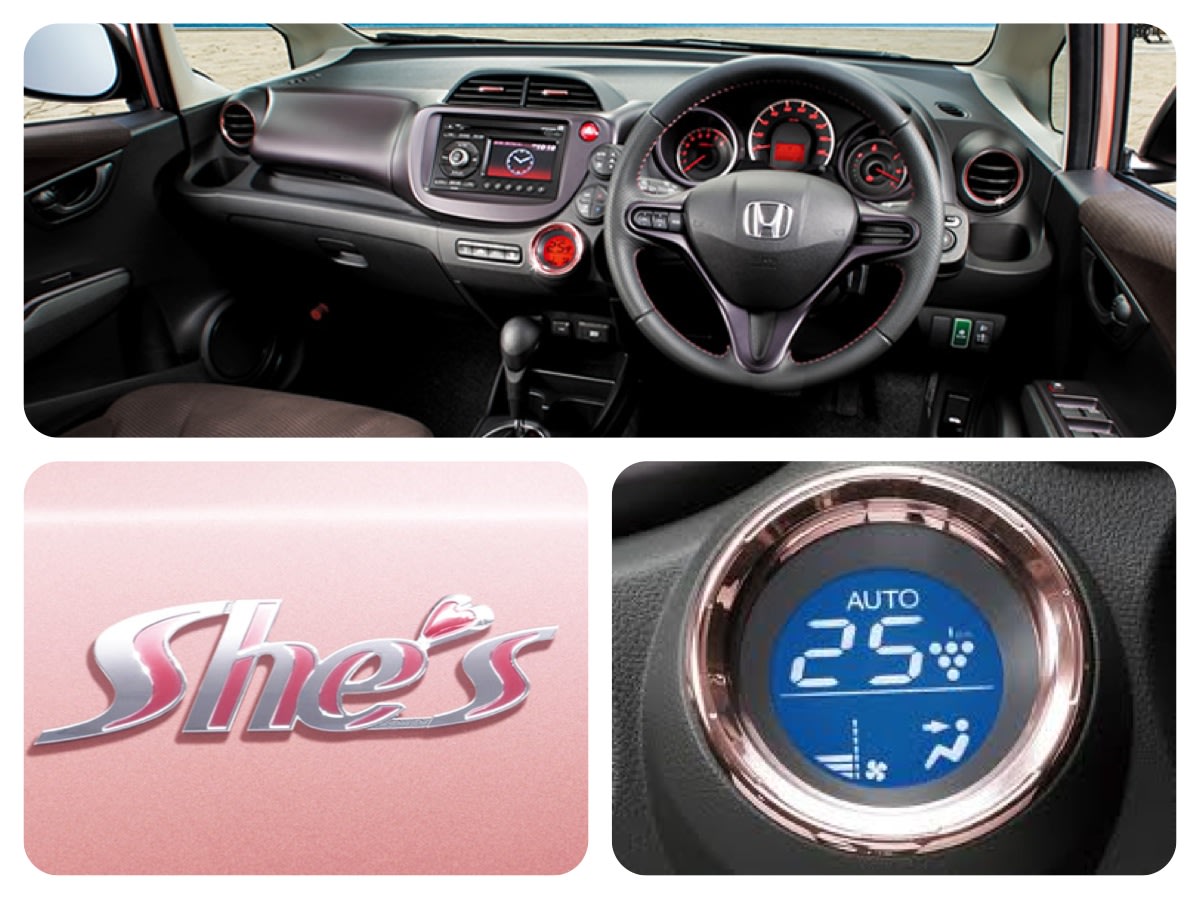
Launched this summer, the Honda Fit She's designers say they wanted to take a regular Fit subcompact and make it in their words "adult cute." That means lots of pink: Pink stitching in the seats and steering wheel and floor mats, matched by pink metallic bezels around the shifter and displays. There's also a few extra shades of pink in the special She's badge, spelled with a heart for an apostrophe. If pink isn't a customer's style, Japanese buyers can also select a Fit She's in shades of brown and white that a Honda executive told the Yomuri Shinbun newspaper match the color of eyeshadow.
To Honda's credit, the Fit She's beauty treatment isn't just skin deep. It also comes with special windshield glass that cuts 99 percent of ultraviolet rays and a "Plasmacluster" air conditioning system that Honda claims can improve a driver's skin quality, all aimed at stopping those wrinkles that turn adult cute into just adult. With a starting price of $17,500, the Fit She's got an attractive price for a home-market Japanese car -- but automakers wouldn't need special editions if taking advice from women wasn't such a noteworthy event.