Tuesday, 24 July 2012

Google's 16GB Nexus 7 Disappears from Play Store


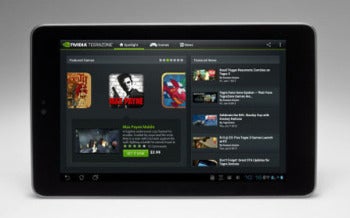
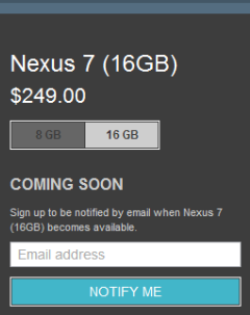
Google’s $250 16GB Nexus 7 tablet disappeared from Google’s online Play store over the weekend due to overwhelming demand, according to an online report. A message on Google Play advises tablet shoppers to sign up for e-mail alerts to learn when the tablet is back in stock. 
Google has not said why the 16GB Nexus 7 is no longer for sale, but anonymous sources “close to Google” told the Guardian that the search giant “seriously underestimated” demand.
Google appears to have been dealing with limited supplies of 16GB Nexus 7 devices for some time. The company recently answered concerns about when customers will get their new Google tablets by publishing a rough timetable for delivery.  All 16GB devices ordered through the end of July 11 were supposed ship by July 20, and Google says remaining orders will be shipped by Friday, July 27. 
Recently, stocks of the Nexus 7 were also proving difficult to find on local retail shelves.  GameStop quit taking orders for the Nexus 7 shortly after the tablet started shipping in mid-July, and around the same time Staples announced it was sold out. Staples now lists the Nexus 7 as available in-store only and on special order, and GameStop lists the Nexus 7 16GB tablet as back-ordered.
As usual with any hot new tech item, eBay sellers are offering Nexus 7 devices at a premium for those unwilling to wait for more devices to ship.
While demand for the Nexus 7 is good news for Google, we're also hearing reports of display issues including backlight bleeding, touch responsiveness problems, and defective manufacturing. The Nexus 7 isn’t the first popular tech device to have production quality issues. When the iPhone 4 first debuted, some early customers reported yellow discoloration on the smartphone’s display that was later linked to residue from the manufacturing process. Similarly, some early buyers of the iPad 2 complained of backlight bleeding.
The $200 8GB Nexus 7 is available only through Google Play and is currently shipping within three to five days.

Monday, 23 July 2012

Give that Thunderbolt port--and your wallet--a workout


When Apple showed off Thunderbolt, we all got giddy with nerdy excitement. 10Gbps dual throughput? Yes, I would like that. Then nothing was released. Thunderbolt ports on the MacBook Pro and MacBook Air sat empty and unused as we waited for the peripherals to arrive. So far we’ve gotten high-end RAIDs that are a bit out of the reach of the average Mac user. Finally Thunderbolt gets some consumer love--some pricey, pricey consumer love.

The Seagate GoFlex series of portable hard drives has been around for a few years. One drive can attach to numerous interface adapters so you can use it with USB and FireWire. So for Seagate it was a no-brainer to add a Thunderbolt adapter too. If you’re already part of the GoFlex ecosystem, you’re ready to step up to the fastest interface around. Unfortunately, the adapter has only one port, so you can’t daisy-chain to all the other devices that are slowly (ever so slowly) trickling to the market.
The adapter snaps to the bottom of a Seagate GoFlex series hard drive, but you have to supply the Thunderbolt cable.
Using a Seagate GoFlex over Thunderbolt certainly is fast. We copied the same 1.13GB folder to a 7200-rpm FreeAgent GoFlex drive using the Thunderbolt adapter on a MacBook Air, and then again using USB 2.0. The USB transfer took 45 seconds while the Thunderbolt adapter finished the same task in 17 seconds. The only thing slowing Thunderbolt down is the drive itself. But that speed comes at a price.
Thunderbolt is expensive. The cable--which isn’t included--will set you back $49. The GoFlex Thunderbolt adapter is $99. That’s a $150 investment and you haven’t even bought the drive yet. For around the same price you can get a compatible 1TB USB 2.0 FreeAgent GoFlex for Mac Ultra-portable drive--cable included. 

The bottom line. It’s fast enough that you’ll be upset when you move files to drives connected via USB 2.0 and FireWire. But that speed comes at a steep price.
Product 
GoFlex Thunderbolt Adapter
Company 
Seagate
Contact 
www.seagate.com
Price 
$99.99
Requirements 
Thunderbolt port, Seagate GoFlex external drive
Positives 
Wicked fast.
Negatives 
Wicked expensive.
Score

Streaming Services Increase Pressure on TV


More choices in original programming are surfacing on Hulu and PlayStation 3. Who needs TV?

For instance, last week Larry King returned to the small screen with the launch of Larry King Now on Hulu. King says (on Hulu's blog) that it was the capturing of Osama Bin Laden that convinced him to come out of retirement. When coverage was all over the airwaves and King wasn't part of it, he missed the rush and knew he had to get back in the business. Dramatic story, but I'm not sure how it fits in with his first guest being Family Guy's Seth MacFarlane. We'll see what kinds of guests King on Hulu can draw.
Hulu has also announced its first international co-production. It is partnering with the BBC to produce a fourth season of satirical comedy show The Thick Of It. If, like me, you're unfamiliar with the series you'll be happy to learn that Hulu will start running the first 3 seasons on July 29.PaidContent has more info.
Stepping away from Hulu, Sony has announced another streaming app coming to the Playstation 3. This time it's The Laugh Factory. This app will offer stand-up routines from the Hollywood-based comedy club of the same name. It goes live on September 1 and will be free for all PS3 owners until December. After that it'll cost $3/month.
Some PS3 owners seem to be skeptical of that monthly fee. I'm not much of a comedy fan (anyone will tell you I have no sense of humor) so it's hard for me to judge the value. That seems pretty cheap even if a lot of the content can be found for free by searching YouTube or wherever. The convenience of having it all queued up on the PS3 seems like it'd be worth $3 to me, but I guess we'll see. More info is available on the Playstation Blog.
The other day I speculated that perhaps Sony was ramping up their video streaming efforts in response to Microsoft doing the same. Three new channels (NeonAlley, CrunchyRoll, and The Laugh Factory) in three days is a good start.

Firefox 15 Beta Tackles Memory Leaks


Mozilla has released a beta version of the next version of its Firefox browser with better memory management and significant speed improvements.

"Firefox 15 prevents most memory leaks caused by add-ons, including Firebug," Nicholas Nethercote writes in a Mozilla blog. Firebug is a Firefox add-on for debugging web pages.
"For many users with add-ons installed, this will significantly reduce Firefox’s memory consumption, without requiring upgrades to those add-ons," he adds. "For those users, Firefox 15 is likely to be faster (sometimes drastically so) and less likely to crash, especially if they have multiple add-ons installed and/or keep Firefox running for a long time between restarts." 
Nethercote explains that add-on memory leaks are caused by "zombie compartments," where information from web pages is stored and remains after you close a page or depart from it. Firefox 15 cleans out those compartments, a move that its developers weren't entirely sure would work. Much criticism has been leveled at Firefox since its inception over its piggish memory practices, but in recent months it has made great strides in its memory management. Last November, for instance, it put SpiderMonkey, the Javascript engine used by the browser, on a diet. And in May, it announced its campaign to plug memory leaks in add-ons.
In addition to better memory management, Firefox 15 also supports the Opus audio format. The format, which can be played directly in Firefox 15, offers better compression formats like MP3, Ogg, or AAC; is good for both music and speech; can dynamically adjust bitrate, audio bandwidth and coding delay; and supports both interactive and prerecorded applications. "We think Opus is an incredible new format for web audio," Timothy Terriberry writes in a Mozilla blog. "We’re working hard to convince other browsers to adopt it, to break the logjam over a common [audio] format." The "prime time" version of Firefox 15 is scheduled for availability August 28.

Samsung Plans 64GB Galaxy S3 This Year


COMPLETE COVERAGE
Samsung has confirmed the 64GB model of its Galaxy S3 smartphone will be released later this year.
The Korean hardware giant has cleared up some confusion floating around suggesting the model might have been ditched altogether. When it does arrive, the Galaxy S3 will match the storage capacities available on the Apple iPhone. 
Samsung said, "The 64GB model of the Galaxy S III will be available during the second half of this year. The market availability and timing may vary and will be determined at the time."
The firm hasn't given a more specific time frame for the release or any information on the price of the Galaxy S3 with the highest specification.
We'll have to wait and find out more information but if Samsung waits too long then it will be facing competition from the iPhone 5 which is rumored to arrive sometime over the next few months.
The Galaxy S3 comes with a 4.8in Super AMOLED screen and Android 4.0 Ice Cream Sandwich. It is one of the three smartphones to be selected to support the latest version of the Sky Go app.

Verizon, AT&T, Others Make Big Bucks Sharing Customer Data


A creepy issue is bubbling up in Congress involving the dramatic uptick in the number of requests to cellular carriers from law enforcement for people’s cell phone records.
The number, announced earlier this month by Rep. Ed Markey (D-Massachusetts), is incredible: In the last year federal, state, and local law enforcement agencies have made 1.3 million demands for user cell phone data such as text messages, caller locations, and wiretaps; and that estimate is certainly low, albeit a huge increase compared with previous years.
This week Markey and three other Democrats sent a letter (PDF) to several House Republicans asking for a hearing to look at whether consumer privacy is being sufficiently protected by law enforcement and wireless carriers.
Privacy advocacy groups such as the Electronic Frontier Foundation say it isn’t, considering that much of this cell phone surveillance is done without a warrant. 
But even more troubling is the fact that cellular carriers actually make a lot of money handing over their user’s private information.
In the July 16 letter the authors wrote, “The carriers’ responses also show that they are being compensated for providing this information to law enforcement agencies. Verizon charges to law enforcement ranged from $50 to retrieve up to five days of stored text message content to $1825 for multiple wiretap switches. AT&T received more than $8.2 million in 2011 for ‘collecting and submitting customer phone usage information to law enforcement.’”
In case you think you don’t have anything to hide, keep in mind the kinds of things your cell phone data can bring to light.
According to the EFF, cell phone location information -- which it says is protected by the Fourth Amendment prohibition against search and seizure -- “can reveal the most intimate details of one’s life,” including things like if a person regularly attends church, drinks heavily, exercises frequently, or cheats on a spouse.
The EFF also notes that Markey “and other members of Congress are working on legislation that would draw a clearer line on how the police can get access to such data,” although the advocacy group points out the Obama administration has previously argued that it’s “burdensome” to require law enforcement to get a warrant for personal information such as cell phone data.

Google Nexus 7 Display Problems Reported


Google's Nexus 7 has been flying off the shelves, but not everyone is completely satisfied with the user experience. The culprit? Problems have cropped up with the tablet's display, according to some reports. These issues aren't terribly surprising considering the Nexus 7 is a budget device that sells for only $199 and $249 for the 8GB and 16GB models, respectively. And it only costs Google about $160 to make. Here's a rundown of what users have been saying.
Venture Beat's Devindra Hardawar says that at times the device's touchscreen doesn't register inputs while performing data-intensive operations such as updating several apps simultaneously or syncing the tablet with several apps from a phone. And Ryan Whitwam at Geek.com reports that touch response consistently fails on parts of the screen when playing graphics-intensive games on the Nexus 7. To fix the issue, he recommends turning the screen off and then back on. While these issues may be solved with a future software update, some people are reporting hardware issues with the Nexus 7 display, as well. PocketNow posted images of a Nexus 7 with a backlight bleeding issue. And Android Authority reports that the displays on some units aren’t properly screwed in, causing them to come out of the tablet's plastic bezel and creak when touched. If you're having problems you can always return the Nexus 7 and get a different one. That said, you might have to wait a bit to get a replacement considering the units are proving difficult -- if not impossible -- to find. Despite reports that Google’s new tablet has some issues, many people who ordered the Nexus 7 finally got their units in the mail this week and from what people are posting online it looks like the vast majority of users absolutely love it.
Indeed, after reviewing the Google Nexus 7,PCWorld's Melissa Perenson said of today's 7-inch Android tablets, the Nexus 7 is the one to beat, and the tablet resets expectations of what an inexpensive tablet can and should be. And about the display in particular, Perenson wrote "The front face is composed of smooth, scratch-resistant Corning glass (but not Corning's Gorilla Glass). The glass is optically bonded to the 7-inch, 1280-by-800-pixel display, which makes a tremendous difference in the device's image quality. With no air gap in play, text looks crisper, contrast is better, and glare is mitigated (although not eliminated). At 216 pixels per inch, the Nexus 7 is clearly far ahead of other 7-inch tablets' pixel density of 170 ppi, and the difference is palpable."